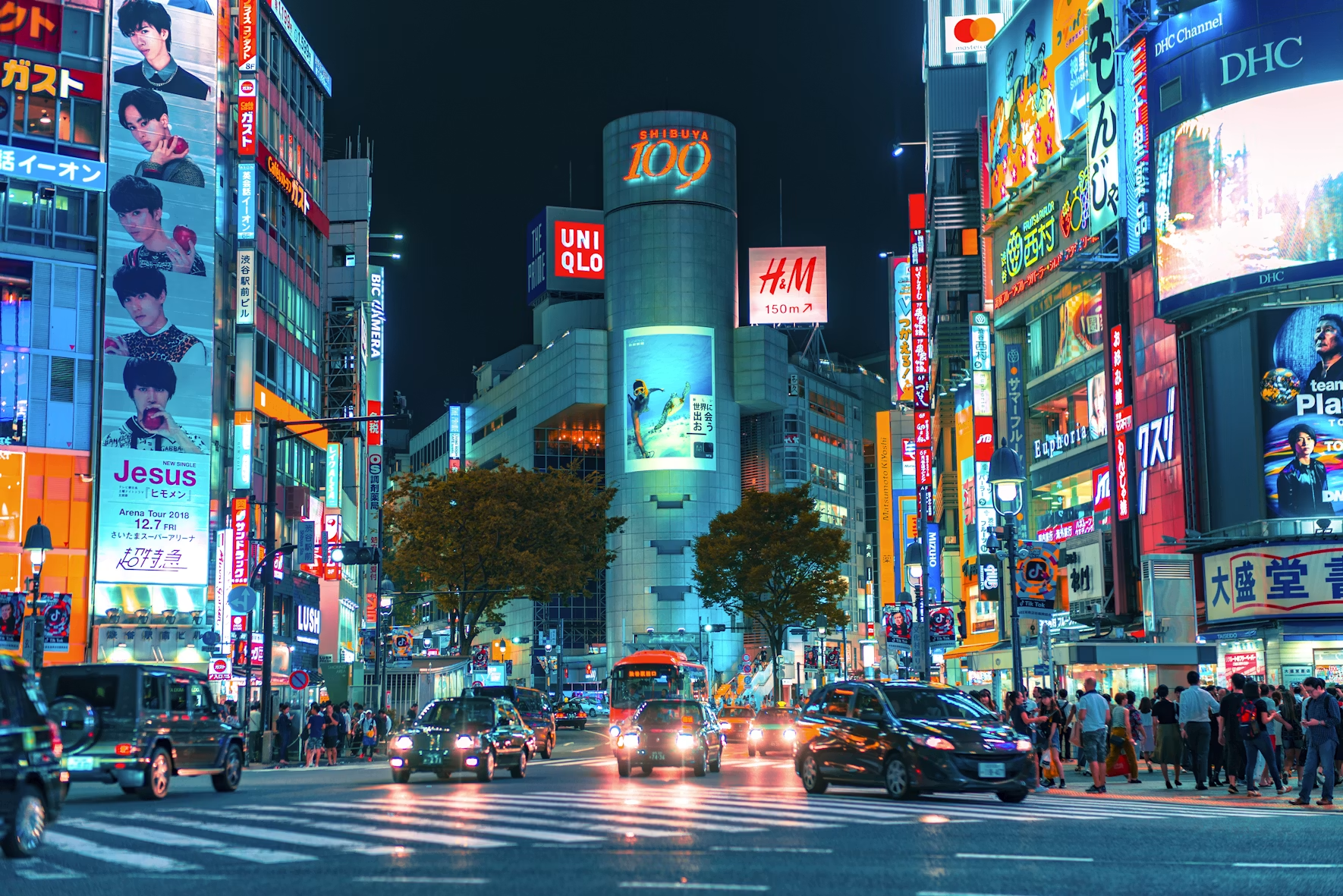
Japan runs one of the world's deepest advanced-industry talent markets: global leadership in robotics and precision engineering, a central role in the semiconductor supply chain, a growing AI sector, one of the deepest corporate-R&D bases anywhere, and Tokyo as a top-tier financial center. All of it generates O-1A extraordinary ability records. Japan also holds one of the largest E-2 treaty relationships with the US — but for founders and professionals who want a direct path to a green card, O-1A is usually the stronger starting point.
Five sectors where Japanese O-1A records develop at scale.
Japan's O-1A landscape is anchored in advanced industry more than any other country in this cluster. It leads the world in robotics and precision engineering — FANUC and Yaskawa among the global leaders — and sits at the center of the semiconductor supply chain through Tokyo Electron, Renesas, Sony image sensors, and a dense network of materials and equipment suppliers. Its AI sector, though younger, is growing fast around Preferred Networks, Sakana AI, and university groups.
Beyond deep tech, Japan has one of the deepest corporate-R&D bases in the world: Toyota (and the Toyota Research Institute), Sony, Hitachi, Panasonic, and Fujitsu generate engineers and scientists with substantial patent and publication records. Tokyo, one of the world's largest financial centers, adds finance professionals at Nomura, MUFG, SMBC, and the global banks' Japan operations. Japan also holds one of the largest E-2 Treaty Investor relationships with the US, so founders and investors have a capital-driven option alongside these merit-based categories — but O-1A pairs directly with an EB-1A or NIW green card, which E-2 does not.
Robotics & precision engineering
World-leading industrial robotics and precision engineering (FANUC, Yaskawa, and university labs); engineers build O-1A records through original contributions (control methods or devices adopted into production, documented with patents), critical role (principal or chief engineer), scholarly or conference papers (IEEE ICRA/IROS), and high salary benchmarked against US roles.
Semiconductors
Central to the global supply chain — Tokyo Electron, Renesas, Sony image sensors, and materials and equipment suppliers; senior engineers qualify through original contributions (process technologies or device designs adopted by the field), critical role (principal engineer or technical lead), high salary, and publications — with domestic-manufacturing a documented US priority driving recruitment.
AI — Preferred Networks & Sakana AI
A growing frontier AI sector; researchers and engineers satisfy original contributions (architectures or methods adopted by the field), scholarly articles (NeurIPS, ICML, ICLR), and critical role through technical leadership on widely cited or deployed systems; publication-forward labs generate well-documented contribution records.
Toyota, Sony & corporate R&D
One of the deepest corporate-research bases in the world; senior engineers and scientists at Toyota, Sony, Hitachi, Panasonic, and Fujitsu qualify through original contributions (technologies or systems adopted into products, documented with patents), critical role (chief researcher or principal engineer), and high salary benchmarked against US roles.
Tokyo finance
One of the world's largest financial centers — Nomura, MUFG, SMBC, and global-bank Japan operations; Japanese nationals in quant finance, trading, and structured products qualify through critical role (director/MD-level positions), high salary (benchmarked against US pay bands), press (Nikkei, Financial Times), and contributions (models or products adopted within the firm).
E-2 treaty available
Japan holds one of the largest E-2 Treaty Investor relationships with the US, giving Japanese founders and investors a capital-driven nonimmigrant alternative to the merit-based O-1A, EB-1A, and NIW categories; O-1A is generally the stronger long-term choice for professionals who want a direct path to a green card.
Eligibility criteria
The O-1A criteria for Japanese professionals.
Three of eight criteria must be satisfied. For Japanese professionals, the criteria most commonly satisfied differ by sector — robotics, semiconductor, and engineering cases lean on contributions, critical role, and patents; AI cases lean on contributions, articles, and critical role; finance cases lean on high salary, critical role, and press. Three to five well-documented criteria is the goal.
01 — PRIZES
Awards & prizes
Japan Society of Applied Physics, IEEE, or robotics-society technical awards; industry innovation awards; JSPS or government research recognitions; startup and venture recognitions for founders.
02 — MEMBERSHIP
Exclusive membership
Fellowship of the IEEE or field-specific international societies requiring outstanding achievement judged by recognized experts; membership in the Engineering Academy of Japan; editorial board service on major peer-reviewed journals.
03 — PRESS
Published material about the person
The Nikkei and Nikkei Asia; IEEE Spectrum and trade/technical press for engineers; TechCrunch and Bloomberg for founders and startups; the Financial Times for finance professionals — coverage documenting the significance of the petitioner's work.
04 — JUDGING
Judging others' work
JSPS or government grant review panels; peer review for IEEE journals, Nature, or top AI venues; program committee service for robotics, semiconductor, or AI conferences; industry standards-body working groups; doctoral examination service.
05 — CONTRIBUTIONS
Original contributions of major significance
Robotics or control methods adopted into production; semiconductor process technologies or device designs adopted by the field; AI architectures or methods adopted at Preferred Networks or academic groups; product technologies adopted at scale at Toyota, Sony, or Hitachi; trading models adopted at a Tokyo institution.
06 — ARTICLES
Scholarly articles
IEEE Transactions and robotics/materials journals for engineers; NeurIPS, ICML, or ICLR for AI researchers; applied-physics and semiconductor journals for device specialists; quantitative-finance journals for finance professionals.
07 — CRITICAL ROLE
Critical or essential role
Principal engineer or chief researcher at FANUC, Yaskawa, Tokyo Electron, Toyota, Sony, or Hitachi; research scientist or technical lead at Preferred Networks or Sakana AI; director or MD at a Tokyo financial institution; founder or senior executive at a well-funded startup.
08 — HIGH SALARY
High salary
Senior Japanese engineering, AI, and finance compensation, benchmarked against equivalent US occupational pay bands using Radford, McLagan, or industry survey data — top-tier Japanese technical and banking compensation frequently translates into high US percentiles once properly documented.
Japan O-1A profiles
What qualifying records look like here.
Representative profiles from Japanese O-1A petitions. Identifying details have been generalized.
Principal Engineer, Robotics
Industrial automation major — Japan
Force-control and safety systems for collaborative robots
15 US and Japanese patents; methods adopted into production robot lines
Papers at IEEE ICRA and IROS; recruited by a US automation company
Technical lead on a multi-year collaborative-robot program
Compensation at high percentile per US robotics engineering survey data
Criteria satisfied: contributions (production-adopted control and safety methods, documented with patents and expert letters from US robotics faculty), articles (ICRA/IROS), critical role (principal engineer on a major program), high salary. O-1A filed by the prospective US employer with premium processing.
Senior Research Scientist
AI company — Tokyo
Deep-learning methods for industrial and robotics applications
9 publications at NeurIPS, ICML, and CVPR; 1,600+ citations
Method adopted in widely used open-source and industrial systems
NeurIPS and CVPR program committee reviewer
Recruited by a US AI lab for a research scientist position
Criteria satisfied: articles (NeurIPS/ICML/CVPR), contributions (method adoption and citation record, documented with expert letters from AI faculty at peer institutions), judging (program committees), critical role (senior research scientist at a recognized lab). O-1A filed by the prospective US employer.
Chief Engineer, Semiconductors
Semiconductor equipment/device maker — Japan
Process technology for advanced-node device fabrication
19 patents; process technology adopted into volume manufacturing
Publications in applied-physics and semiconductor journals
Technical lead recruited for a US fab-expansion program
Compensation at high percentile per US semiconductor survey data
Criteria satisfied: contributions (manufacturing-adopted process technology, documented with patents and expert letters), articles (applied-physics journals), critical role (chief engineer), high salary. O-1A filed ahead of a US-based assignment tied to domestic semiconductor expansion.
O-1A and the Japanese E-2 treaty
Why O-1A often beats E-2 for Japanese founders.
Japan holds one of the largest E-2 Treaty Investor relationships with the US, giving Japanese founders and investors a capital-driven nonimmigrant option. But E-2 requires an active, substantial investment and ongoing direction of the enterprise, and it does not itself lead to a green card — an E-2 holder can renew indefinitely without ever moving closer to permanent residence. For Japanese professionals in robotics, semiconductors, AI, engineering, and finance whose personal record — contributions, patents, publications, or a senior role — already tells a strong individual story, O-1A is often the better-positioned category, because it pairs directly with an EB-1A or EB-2 NIW filing using the same evidentiary record.
Japan's professional base is unusually well-suited to O-1A: the concentration of world-leading engineering, semiconductor, and corporate-research organizations generates exactly the documented critical roles, high compensation, and original contributions the category requires. Premium processing (15 business days) is commonly used given the pace of hiring cycles.
Treaty status
Japan has one of the largest E-2 Treaty Investor relationships with the United States. It is a capital-driven nonimmigrant option for founders and investors, but it does not lead to a green card. O-1A, EB-1A, and EB-2 NIW are the merit-based routes — and the ones that pair with a direct path to permanent residence.
FAQ
Japan O-1A questions.
Yes. Japan holds one of the largest and longest-standing E-2 treaty relationships with the United States, so Japanese citizens can qualify for E-2 status by investing in and actively directing a bona fide US enterprise. E-2 is capital-and-business-plan-driven, while O-1A is merit-based and requires no investment. Japanese founders and professionals with a documented individual record typically find O-1A a stronger long-term option, particularly because it pairs directly with an EB-1A or EB-2 NIW green card filing, which E-2 does not.
Yes. Japan leads the world in robotics (FANUC, Yaskawa) and has a growing AI sector (Preferred Networks, Sakana AI, and academic groups). Engineers and researchers satisfy O-1A criteria through original contributions (a control method, model architecture, or system adopted into production or by the field, documented with patents or citation analysis), scholarly articles or conference papers (IEEE ICRA/IROS, NeurIPS, ICML), critical role (principal engineer, chief researcher, or technical lead), and high salary benchmarked against US roles. Premium processing is commonly used given hiring timelines.
Yes. Japan's corporate-research and engineering base is one of the deepest in the world. Engineers and scientists at Toyota, Sony, Hitachi, Panasonic, and Fujitsu build O-1A records around original contributions (technologies or systems adopted into products, documented with patents), critical role (a principal-engineer or chief-researcher position), high salary (benchmarked against equivalent US engineering pay bands), and publications where applicable. Expert letters from US-based academic and industry peers are especially important for corporate profiles.
Yes. Japan's semiconductor ecosystem — Tokyo Electron, Renesas, Sony image sensors, and materials and equipment suppliers — is central to the global supply chain. A senior semiconductor engineer builds an O-1A record through original contributions (process technologies or device designs adopted by the field, documented with patents), critical role (a principal-engineer or technical-lead position), high salary, and publications. With domestic-manufacturing a documented US priority, US employers increasingly recruit Japanese semiconductor talent, and O-1A's cap exemption accommodates that timing.
Yes. Tokyo is one of the world's largest financial centers, home to Nomura, MUFG, and SMBC alongside the global banks' Japan operations. Japanese nationals in quantitative finance, trading, and structured products build O-1A records through critical role (a director or MD title at a globally recognized institution), high salary (benchmarked against US pay bands), press coverage (the Nikkei or the Financial Times), and original contributions (a model, strategy, or product structure adopted within the firm).