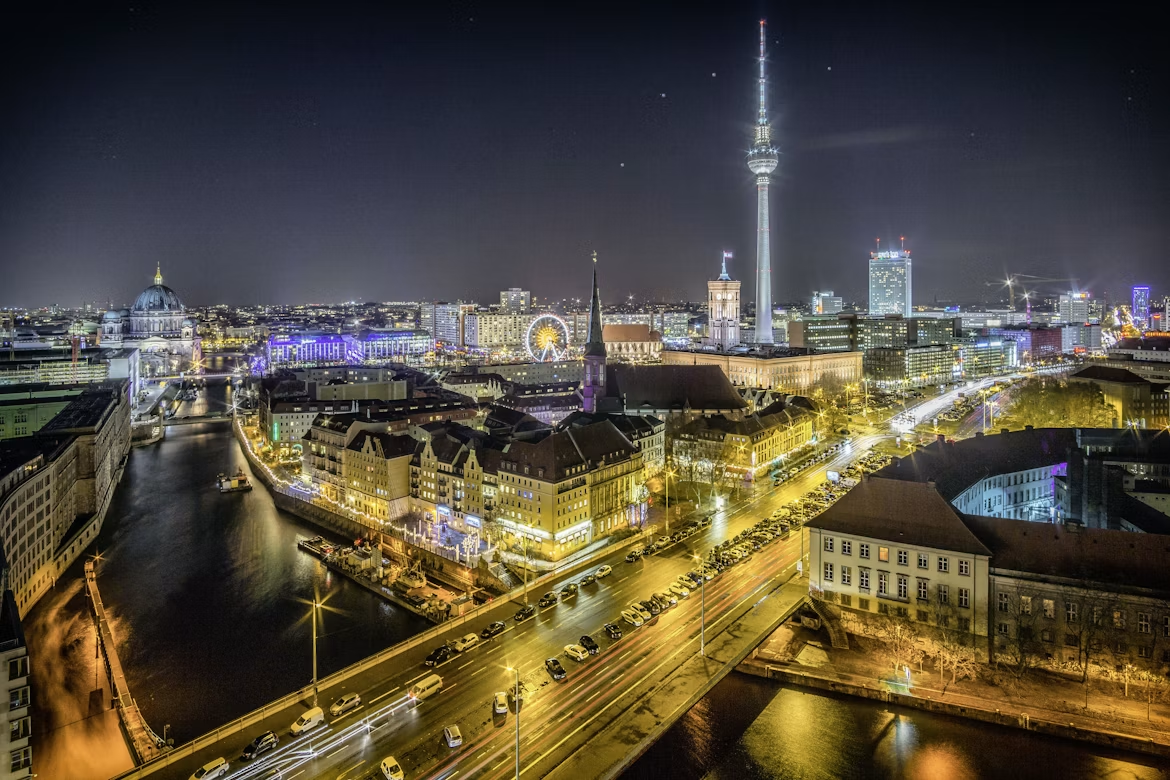
Germany generates O-1A petitioners across a wider range of sectors than almost any other country: Berlin is Europe's most active startup hub by venture investment, the Max Planck Society and Fraunhofer Institutes are among the largest research organizations in the world, and BMW, Siemens, Bayer, and BASF anchor engineering and pharmaceutical sectors with deep patent and publication records. Germany also holds an E-2 treaty with the US, giving founders and investors an additional option.
Four sectors where German O-1A records develop at scale.
Germany's economic and research landscape produces O-1A petitioners across a broader range of backgrounds than most countries of comparable size. Berlin has become Europe's most active startup hub by venture investment volume, with well-capitalized companies including Zalando, Delivery Hero, N26, and AUTO1 Group generating a generation of founders and senior executives with documented records of original contribution and critical role in globally recognized organizations. A second strand is academic and applied research: the Max Planck Society operates 84 institutes focused on basic science, and the Fraunhofer Society operates 76 institutes focused on applied technology transfer — together representing one of the most substantial research infrastructures in the world.
A third strand is engineering: BMW, Siemens, Bosch, and BASF employ engineers whose patent portfolios and production-adopted innovations routinely satisfy the original contributions and critical role criteria. A fourth is pharmaceutical research: Bayer and Boehringer Ingelheim, both among the world's largest pharmaceutical companies by R&D investment, generate scientists with deep publication and patent records. Germany's E-2 treaty with the US provides founders and investors a capital-driven nonimmigrant alternative alongside these merit-based categories.
Berlin startup ecosystem
Europe's most active startup hub by venture investment; founders and senior executives at Zalando, Delivery Hero, N26, and AUTO1 Group anchor to critical role, original contributions, press (Handelsblatt, Der Spiegel, Bloomberg), and high salary benchmarked against US comparable roles.
Max Planck Society
84 institutes focused on basic research across life sciences, physics, and the humanities; researchers satisfy original contributions, scholarly articles, judging through DFG or European Research Council grant panels, and critical role through institute director or group-leader positions.
Fraunhofer Society
76 applied research institutes focused on technology transfer and industrial innovation; scientists and engineers build O-1A records through patents, original contributions adopted in production environments, and critical role at the division director or senior researcher level.
BMW, Siemens & German engineering
Globally recognized manufacturers with deep patent portfolios; engineers satisfy original contributions (innovations adopted into production) and critical role (senior or principal engineering titles), with high salary benchmarked against US engineering pay bands.
Bayer & Boehringer Ingelheim
Two of the world's largest pharmaceutical companies by R&D investment; scientists qualify through original contributions (drug candidates or formulation methods documented with patents), scholarly articles, judging through peer review, and critical role at the principal scientist or director level.
E-2 treaty available
Germany has an E-2 Treaty Investor agreement with the US, giving German founders and investors a capital-driven nonimmigrant alternative to the merit-based O-1A, EB-1A, and NIW categories; O-1A is generally the stronger long-term choice for professionals who want a direct path to a green card.
Eligibility criteria
The O-1A criteria for German professionals.
Three of eight criteria must be satisfied. For German professionals, the criteria most commonly satisfied differ by sector: startup cases lean on original contributions, press, and critical role; research cases lean on contributions, articles, and judging; engineering cases lean on contributions, critical role, and high salary.
01 — PRIZES
Awards & prizes
DFG research prizes, Leibniz Prize, Federal Cross of Merit for science, German Startup Award, automotive and engineering industry prizes from VDI or VDMA, pharmaceutical industry awards.
02 — MEMBERSHIP
Exclusive membership
German National Academy of Sciences (Leopoldina) membership; acatech membership; editorial board service on leading peer-reviewed journals; membership in professional bodies requiring achievement as judged by recognized experts.
03 — PRESS
Published material about the person
Handelsblatt and Wirtschaftswoche for finance and business; Der Spiegel, Zeit, and Frankfurter Allgemeine for broader coverage; TechCrunch and Bloomberg for startup and tech coverage; Nature News and STAT News for pharma and biotech.
04 — JUDGING
Judging others' work
DFG grant review panels; European Research Council grant review; peer review for Nature, Cell, or leading engineering journals; conference program committee service at top international venues (NeurIPS, ICML, CVPR).
05 — CONTRIBUTIONS
Original contributions of major significance
A startup product or platform adopted across an industry; a research method adopted across the field, documented with citation analysis; a patent on a method incorporated into production at BMW, Siemens, or Bosch; a drug candidate advanced through clinical development at Bayer or Boehringer Ingelheim.
06 — ARTICLES
Scholarly articles
Publications in Nature, Science, Cell, or field-leading journals for researchers; IEEE Transactions or top engineering conferences for engineers; Nature Medicine or The Lancet for pharma scientists.
07 — CRITICAL ROLE
Critical or essential role
C-level or VP at a Berlin startup with documented market position and investor backing; Max Planck or Fraunhofer institute director or group leader; principal scientist or director at Bayer or Boehringer Ingelheim; senior or principal engineer at BMW or Siemens.
08 — HIGH SALARY
High salary
Senior Berlin tech and German engineering/pharma compensation, benchmarked against equivalent US occupational pay bands — senior technical and executive roles in Germany often translate into strong US percentiles when properly documented.
German O-1A profiles
What qualifying records look like here.
Representative profiles from German O-1A petitions. Identifying details have been generalized.
VP of Engineering
Series C fintech startup — Berlin
Real-time risk scoring infrastructure for European consumer lending
Led 40-person engineering organization; system processes €2B+ in annual transaction volume
Risk scoring method adopted as an industry reference cited in 3 peer fintech evaluations
Profiled in Handelsblatt fintech coverage and TechCrunch European startup series
Compensation in the 91st percentile per European software engineering survey data
Criteria satisfied: critical role (VP-level at a well-funded, well-recognized Berlin fintech), contributions (risk scoring method adoption, documented with expert letters from finance academics), press (Handelsblatt, TechCrunch), high salary.
Group Leader, Computational Biology
Max Planck Institute — Munich
Statistical methods for single-cell RNA sequencing analysis
22 publications; senior-author papers in Nature Methods and Cell Systems
DFG Emmy Noether grant as principal investigator; peer reviewer for Nature Methods
Invited speaker at Cold Spring Harbor Laboratory and EMBO conferences
Criteria satisfied: articles (Nature Methods, Cell Systems), contributions (method adoption and citation record), judging (Nature Methods peer review, DFG panel service), critical role (Max Planck group leader position at a globally recognized research organization).
Principal Engineer, Powertrain R&D
Global automotive manufacturer — Munich
Battery thermal management systems for electric vehicle platforms
11 granted US and European patents; thermal management architecture adopted in 3 production vehicle platforms
Compensation at 89th percentile per automotive engineering survey data
2 peer-reviewed publications in IEEE Transactions on Vehicular Technology
Expert letters from 4 US-based engineering faculty in thermal systems and EV design
Criteria satisfied: contributions (patents and production adoption, documented with expert letters), critical role (principal engineer on a major production program at a globally recognized manufacturer), high salary, articles (IEEE Transactions).
O-1A and the German E-2 treaty
Why merit often outperforms capital for German applicants.
Germany has an E-2 Treaty Investor agreement with the US, giving German founders and investors a capital-driven nonimmigrant option. But E-2 requires an active, substantial investment and ongoing direction of the enterprise, and it does not itself lead to a green card. For German professionals in tech, research, engineering, and pharma whose personal record — contributions, patents, publications, press coverage, or institutional prestige — already tells a strong individual story, O-1A is often the better-positioned category, because it pairs directly with an EB-1A or EB-2 NIW filing using the same evidentiary record.
Premium processing (15 business days) is commonly used given the pace of Berlin tech hiring cycles. Germany's breadth of globally recognized institutions — from Max Planck and Fraunhofer to BMW, Bayer, and the Berlin startup ecosystem — generates the kind of documented critical roles, original contributions, and press coverage that O-1A requires across a wider range of backgrounds than most countries.
Treaty status
Germany holds an E-2 Treaty Investor agreement with the United States. German founders and investors can pursue E-2 as a capital-driven nonimmigrant alternative. O-1A is generally the stronger long-term choice for professionals with a documented individual achievement record who want a direct path to a green card.
FAQ
Germany O-1A questions.
Yes. Germany has an E-2 treaty with the United States, making German citizens eligible for E-2 status when investing in and actively directing a bona fide US enterprise. E-2 is capital-driven, while O-1A is merit-based and requires no investment. German tech founders and professionals with a documented individual record typically find O-1A a stronger long-term option.
Yes. Berlin is Europe's most active startup hub by venture investment volume, and its founders and senior executives regularly build O-1A records around original contributions (a product or platform adopted across the industry), critical role (a C-level or VP-level position at a well-funded startup), press coverage, and high salary benchmarked against US comparable roles.
Yes. The Max Planck Society and Fraunhofer Society are among the world's most recognized research organizations. Their scientists satisfy O-1A criteria through original contributions (methods adopted across the field), scholarly articles, judging (DFG grant panels, peer review), and critical role (institute director or group-leader positions).
Yes. Engineers at BMW, Siemens, or BASF build O-1A records around original contributions (a patent portfolio or a technical method adopted into production), critical role (a senior or principal engineering position at a globally recognized company), and high salary. Expert letters from academic and industry peers are especially important in non-academic cases.
Yes. Bayer and Boehringer Ingelheim are among the largest pharmaceutical companies in the world, and their scientists frequently satisfy O-1A criteria through original contributions (drug candidates or formulation methods advanced through clinical development, documented with patents), scholarly articles, judging through peer review, and critical role at the principal scientist or director level.