Why Boston generates so many O-1A petitions.
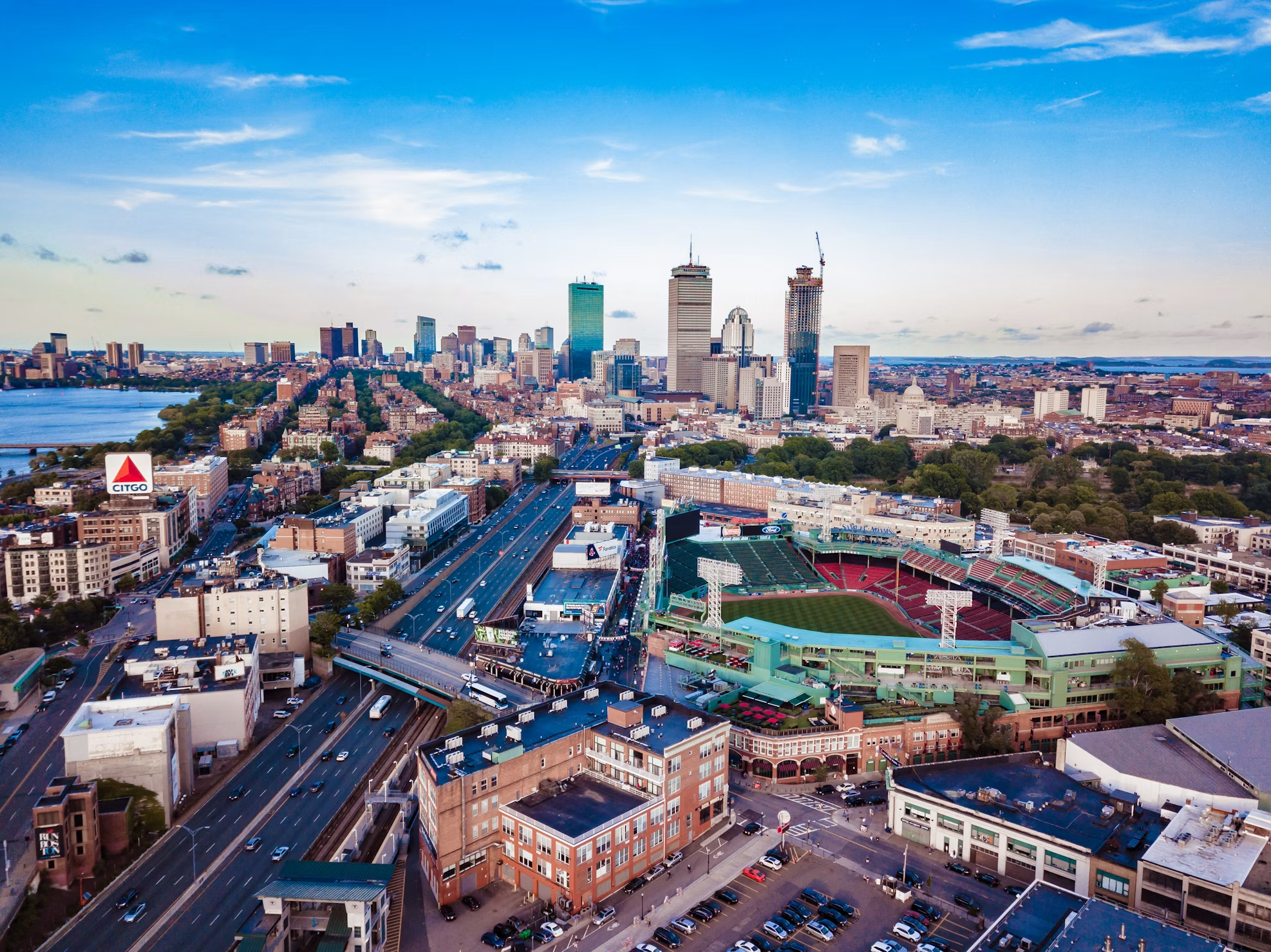
The Greater Boston area is one of the world's densest research environments, and one of the most active markets for O-1A petitions in the country. Within a few square miles of Cambridge, MIT and Harvard anchor the nation's deepest university research infrastructure. The Broad Institute, steps from Kendall Square, runs some of the most-cited genomics and computational biology programs in the world. Dana-Farber Cancer Institute, Mass General Hospital, Brigham and Women's, and Beth Israel Deaconess form a Harvard Medical School teaching hospital network that produces more peer-reviewed oncology and clinical research than any comparable geography in the US.
Kendall Square has evolved from a factory district into the world's most concentrated biotech hub. Biogen, Moderna, Vertex Pharmaceuticals, Sanofi, Pfizer, and Novartis all maintain significant R&D operations within blocks of each other. The result is a labor market where exceptional scientific ability is both a hiring prerequisite and the daily work product. That creates exactly the kind of evidentiary record USCIS looks for when adjudicating extraordinary ability claims.
For immigration purposes, Boston's density is a practical advantage. Peer reviewers and expert witnesses are close at hand. Colleagues at neighboring institutions write informed support letters. Institutional immigration offices at Harvard and MIT have processed hundreds of O-1A petitions and know what USCIS looks for.
In practice, researchers at every career stage, from third-year postdoc to principal investigator to VP of Research at a clinical-stage biotech, regularly meet the O-1A standard. Most need only the right petition strategy to demonstrate it.
Where Boston O-1A petitions originate.
These institutions produce the largest share of Boston-area O-1A petitions. Each has distinct sponsorship practices and research profiles that shape the evidentiary strategy.
Which O-1A criteria apply most to Boston researchers.
O-1A requires at least three of eight regulatory criteria. For Boston researchers and scientists, these five come up most often:
Scholarly articles in professional journals
A strong publication record in peer-reviewed journals (Nature, Science, Cell, NEJM, PNAS, PLOS Biology, Genome Research) typically satisfies this criterion outright. First-authorship and corresponding-authorship carry weight. This is the baseline for most Boston academic profiles.
Original contributions of major significance
NIH-funded discoveries, first-author papers cited 50+ times, methodological breakthroughs, platform technologies, or clinical findings that changed treatment protocols. USCIS looks for evidence that peers have adopted or built on your work: citation analysis, peer letters explaining impact, and downstream publications citing your methodology.
Critical or leading role in a distinguished organization
Principal investigator, lab director, staff scientist leading a program, or principal/senior scientist owning a therapeutic pipeline at a named biotech company. USCIS evaluates whether the role is indispensable to an organization recognized as distinguished. MIT and Harvard labs and Kendall Square companies typically clear that bar with documentation.
Judging the work of others
Ad hoc reviewing for high-impact journals (Nature Methods, Cell, PNAS, JAMA), NIH study section membership, NSF or DOD grant panel participation, conference abstract review, or editorial board positions. Peer review histories are easily documented, and most Boston researchers are doing significantly more of this than they realize.
High salary relative to peers
Biotech compensation at the principal scientist, associate director, and above levels in the Kendall Square corridor frequently places candidates in the top 10-20% of their field nationally. This criterion is most common for industry scientists but also applies to named professorships, endowed chairs, and certain NIH-funded positions.
What qualifying records look like here.
Representative profiles from Boston-area O-1A petitions. Identifying details have been generalized.
Computational biologist, genomics tools
Oncology researcher, tumor immunology
mRNA platform development and delivery
The green card path from Boston.
For most Boston researchers, the O-1A is a first step, not the destination. The same publication record, citation metrics, and peer-review service that support an O-1A petition also support a self-petitioned EB-1A green card — which is why so many MGH, Broad, and Kendall Square scientists file the two together using a shared evidentiary package. If permanence is the goal, the O-1A is best planned as the front half of a two-step strategy.
The natural progression is the O-1 to EB-1A pathway, which explains how an extraordinary-ability visa converts to a green card. Postdocs and research faculty whose records are still maturing often pursue the EB-2 NIW in parallel, given how cleanly NIH- and NSF-funded work maps onto the national-interest standard. And for the many F-1 students finishing degrees at MIT, Harvard, and the Boston-area universities, the F-1 to O-1A pathway is the route that skips the H-1B lottery entirely.